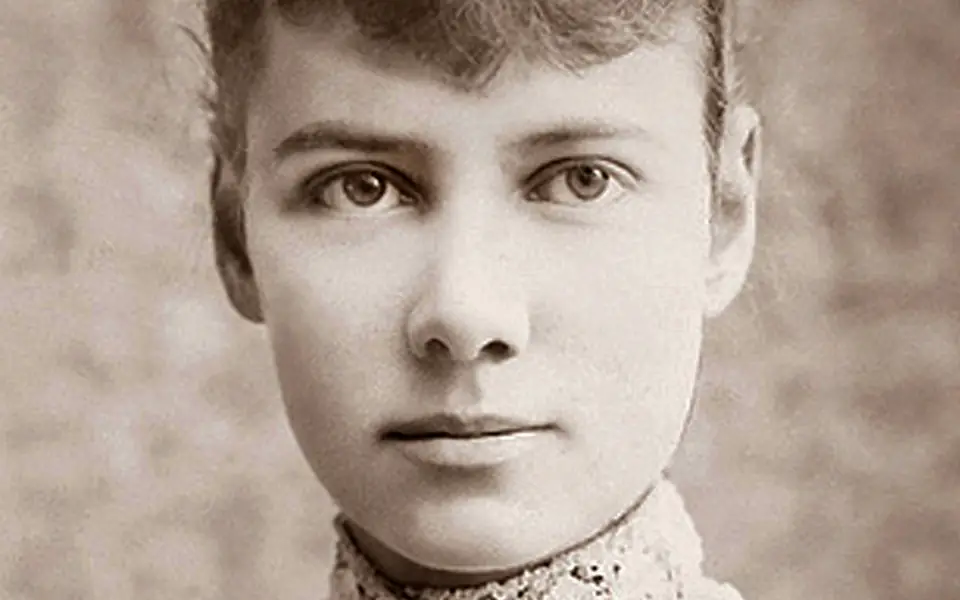
An argument becomes a reporting job
Before Nellie Bly became a headline, she challenged one. Born Elizabeth Cochran in Pennsylvania in 1864, she objected to a newspaper argument that confined women to domestic roles. Her response impressed an editor at the Pittsburgh Dispatch and helped secure her first reporting job. The pen name Nellie Bly followed. That beginning contains a pattern that would recur through her career: she confronted a rule about where women belonged by producing something an editor could publish. Her argument became an opportunity to work.
The opportunity still had limits. Women reporters were often assigned subjects considered suitable for women, while political or investigative work remained harder to obtain. Bly reported on factory conditions and later from Mexico, but wanted room to address a broader audience. Her move to New York placed her in a larger, intensely competitive newspaper world. Finding a position there was difficult. At the New York World in 1887, an extraordinary assignment offered her a way in: investigate the treatment of women held at the asylum on Blackwell's Island.
Inside Blackwell’s Island
Bly entered under an assumed identity after persuading authorities that she needed institutional confinement. Once inside, she documented what patients faced rather than accepting the institution's account of itself. Her reports described poor food, cold, neglect and abusive treatment. She also encountered women whose limited English made it difficult to explain their circumstances to staff. The reporting made a fundamental issue visible: an institution could control not only patients' lives, but whether their own explanations would be believed. Bly's public voice carried those conditions beyond the island.
The articles and the book Ten Days in a Mad-House made her famous. Their impact belonged partly to a newspaper market that prized dramatic revelations, but the conditions she described were not merely material for entertainment. The investigation contributed to pressure for improvements and helped establish her as a reporter willing to gather evidence by entering a situation herself. Her work also encouraged other women to undertake immersive assignments. The technique involved performance and deception at the point of entry, followed by a demand that readers take the reported treatment seriously.
A newspaper journey around the world
In 1889, Bly moved from an enclosed institution to a journey around the globe. Jules Verne's fictional eighty-day trip supplied a recognizable target; the World supplied a platform through which readers could follow her progress. She left on November 14 and traveled eastward. A detour in France took her to meet Verne at Amiens, turning the literary origin of the undertaking into part of the real journey. Steamships and trains carried her between distant places, while their timetables decided how rapidly she could move onward.
The return became a public spectacle. On January 25, 1890, she reached Jersey City after about seventy-two days, greeted by an enthusiastic crowd. The Evening World's special coverage turned the finish into a celebration and highlighted her small amount of luggage. The trip combined real travel with the newspaper's ability to make readers feel involved in a continuing event. Bly was reporting the world, but the world was also reading about Bly. Her personal visibility had become a working instrument that could draw an audience toward the next installment.
A career beyond the famous assignments
Her life continued beyond those two celebrated assignments. She later married industrialist Robert Seaman and took responsibility for manufacturing businesses after his death. She pursued inventions and employee benefits, though the businesses encountered serious financial trouble. Returning to journalism, she reported from Europe during the First World War. She also supported women's suffrage. These later chapters resist a tidy ending in which an adventurous young reporter completes a famous race and disappears: Bly kept attempting new forms of work and public influence through changing circumstances.
Bly died in 1922, leaving articles, books and an unusually recognizable reporting persona. Her reputation invites a useful distinction between entering a story and understanding it. Travel made her visible; the asylum investigation made otherwise confined experiences visible to readers. Both depended on her willingness to become a participant, but their consequences were different. Taken together, they show how a woman working within a competitive newspaper industry could use attention to cross professional boundaries, while raising enduring questions about how journalists obtain evidence and whose experiences become news.