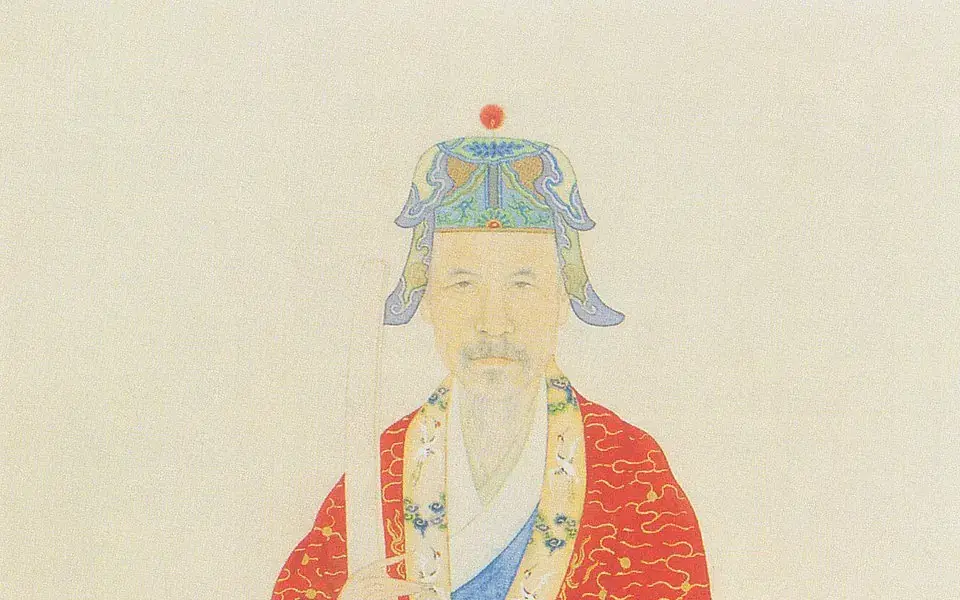
Wen Tianxiang wrote Crossing Lingding Ocean during his experiences after capture. The poem links place names such as Huangkong Shoal and Lingding Ocean with his personal circumstances.
His resistance to the Yuan is connected with the fall of the Southern Song. The poem later entered education and public memory, showing the work's continuing circulation.
Biography
Wen Tianxiang was born on 6 June 1236 in Luling (Ji'an), Jiangxi Province during the Song dynasty. At the age of 18, he excelled in his local examinations, and two years later participated in examinations in the capital, during which he was personally awarded first rank (Zhuangyuan) by Emperor Lizong. He would subsequently take up several posts in the government of the Southern Song, including being Attendant of the Justice Ministry and Prefect of Ganzhou. Wen Tianxiang was frequently in conflict with the corrupt magistrate Jia Sidao and the pro-peace faction as he supported the war effort against the invading Mongols. Wen once requested the execution of a eunuch who proposed fleeing from the capital Lin'an. As a result, Wen was demoted and forced into premature retirement at the age of 37.
Later when the war situation further deteriotated, Wen was recalled an appointed as the Prefect of Ganzhou. He immediately recruited some troops from the local population and was later assigned to defend the region of Pingjiang (now in Suzhou, Jiangsu). In 1275, Yuan Mongols troops under Bayan attacked the Jiangsu and Jiejiang regions. Yuan forces quickly bypassed Pingjiang and marched directly to the region now known as Yuhang District. Wen Tianxiang hurriedly rushed to Yuhang but he was too late, his former base in Pingjiang was also quickly overwhelmed by the Mongols. Wen and his troops then retreated back to Lin'an. Together with Zhang Shijie, Wen Tianxiang proposed a plan to keep fighting, but it was rejected by Chancellor of the Right Chen Yizhong.
At that time many Song court officials (including Chancellor of the Left Liu Mengyang) had already run away fearing the approaching Yuan troops, while others were mostly pro-peace. Pro-war figures like Zhang Shijie also left to continue the fight on their own. The Song Empress Dowager finally decided to surrender, and Wen was appointed as the new Chancellor of the Right to lead the Song delegation to ask the Yuan for peace (1276).
Seeing that Wen Tianxiang was determined to not surrender, Bayan arrested Wen in the Mongol headquarters. An enraged but helpless Wen Tianxiang could only witness the Empress Dowager and other Song court officials finalize their surrender. Nonetheless, Wen managed to escape from the Yuan Mongol camp, and head to Yang province. The Yang prefect wrongly suspected Wen as a spy from the Yuan, therefore Wen further travelled south and finally met Zhang Shije and Chen Yizhong in Fuzhou, this time with a newly crowned Emperor Duanzong. After a brief discussion, Wen travelled to Nanjian pronvince (now located as Nanping, Fujian province) to recruit troops, then marched to Jiangxi. Wen managed to gain several victories, but he was soon overwhelmed by the Yuan forces led by Zhang Hongfan and was captured (7 February 1278).
The Yuan court continued trying to persuade Wen Tianxiang to serve it. Former Song chancellor Liu Mengyan visited him in prison, but Wen rejected the appeal. The captured Emperor Gong of Song was also sent to speak with him, as was his brother Wen Pi. These encounters placed political loyalty beside powerful personal obligations. Wen received letters from his daughter and learned that members of his family were being held captive in the Yuan palace. The record of these pressures helps explain why later readers associated him with fidelity under extreme hardship.