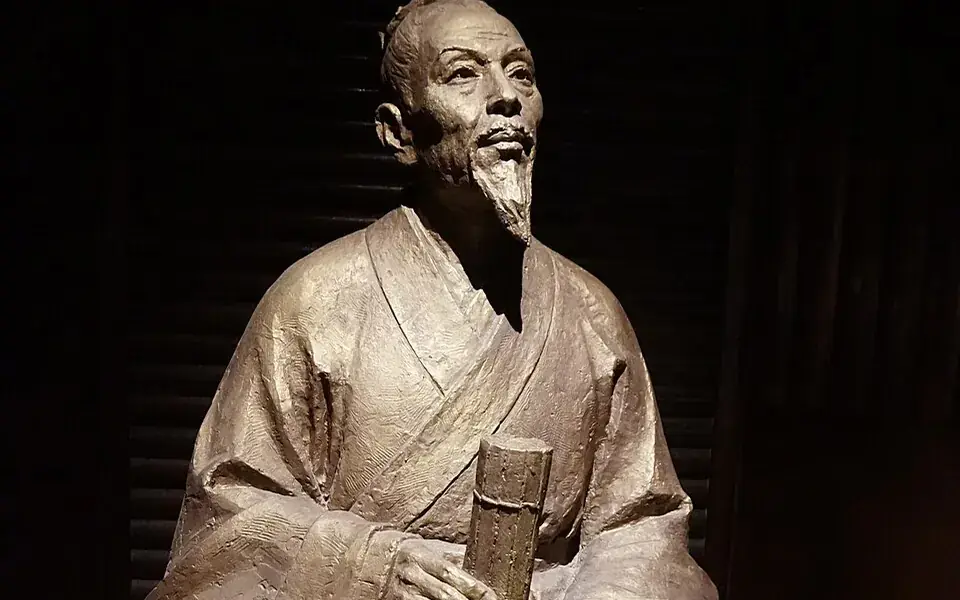
Zu Chongzhi bounded pi between two very close numbers and proposed both a simpler and a more precise approximation, demonstrating the sophistication of ancient mathematical calculation.
His complete calculation has not survived. Later scholars study the methods through historical accounts; a modern reconstruction should not be described as his original manuscript.
Life and works
Chongzhi's ancestry was from modern Baoding, Hebei. To flee from the ravages of war, Zu's grandfather Zu Chang moved to the Yangtze, as part of the massive population movement during the Eastern Jin. Zu Chang at one point held the position of Chief Minister for the Palace Buildings within the Liu Song and was in charge of government construction projects. Zu's father, Zu Shuozhi, also served the court and was greatly respected for his erudition.
Zu was born in Jiankang. His family had historically been involved in astronomical research, and from childhood Zu was exposed to both astronomy and mathematics. When he was only a youth, his talent earned him much repute. When Emperor Xiaowu of Song heard of him, he was sent to the Hualin Xuesheng academy, and later the Imperial Nanjing University (Zongmingguan) to perform research. In 461 in Nanxu (today Zhenjiang, Jiangsu), he was engaged in work at the office of the local governor. In 464, Zu moved to Louxian (today Songjiang district, Shanghai), there, he compiled the Daming calendar and calculated π.
Zu Chongzhi, along with his son Zu Gengzhi, wrote a mathematical text entitled Zhui Shu ("Methods for Interpolation"). Though originally one of the Ten Computational Canons, this book has been lost since the Song dynasty.
Astronomy
Zu was an accomplished astronomer who calculated the time values with unprecedented precision. His methods of interpolation and the use of integration were far ahead of his time. Even the results of the astronomer Yi Xing (who was beginning to utilize foreign knowledge) were not comparable. The Song dynasty calendar was backwards to the "Northern barbarians" because they were implementing their daily lives with the Daming calendar. It is said that his methods of calculation were so advanced that the scholars of the Song dynasty and Indian-influenced astronomers of the Tang dynasty found them confusing.
Mathematics
The majority of Zu's great mathematical works are recorded in his lost text the Zhui Shu. It is said that the treatise contained formulas for the volume of a sphere, cubic equations and an accurate value of pi. Most schools argue about his complexity since traditionally the Chinese had developed mathematics as algebraic and equational. Logically, scholars assume that the Zhui Shu yields methods of cubic equations. His works on the accurate value of pi describe the lengthy calculations involved. Zu used Liu Hui's π algorithm described earlier by Liu Hui to inscribe a 12,288-gon. Zu's value of pi is precise to six decimal places and for almost nine hundred years thereafter no subsequent mathematician computed a value this precise. Zu also worked on deducing the formula for the volume of a sphere with his son Zu Gengzhi.
In their calculation, Zu used the concept that two solids with equal cross-sectional areas at equal heights must also have equal volumes to find the volume of a Steinmetz solid. And further multiplied the volume of the Steinmetz solid with π/4, therefore found the volume of a sphere as πd^3/6 (d is the diameter of the sphere).