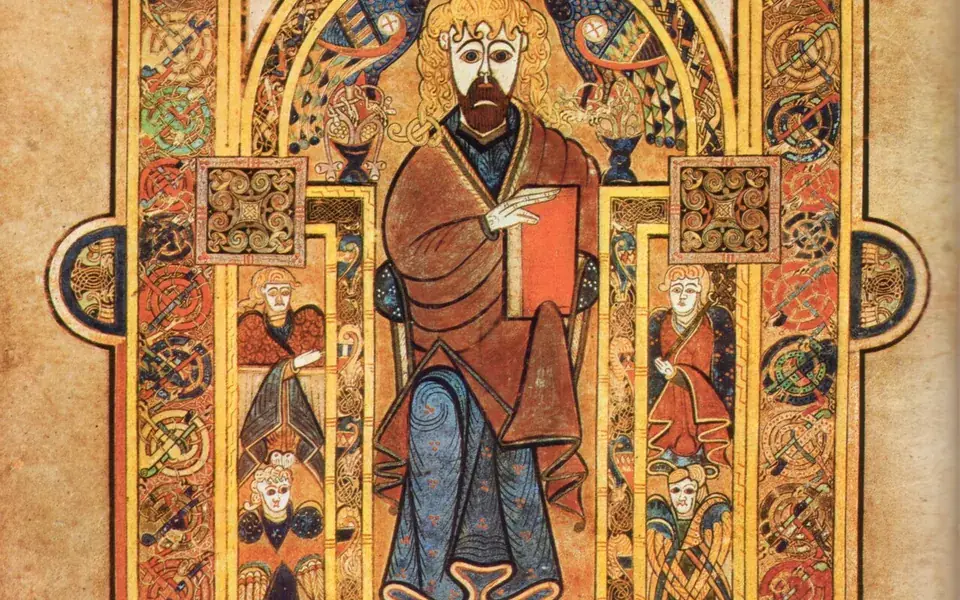
The Book of Kells (Codex Cenannensis; Leabhar Cheanannais; Library of Trinity College Dublin, MS A. I., sometimes known as the Book of Columba) is an illustrated manuscript and Celtic Gospel book in Latin, containing the four Gospels of the New Testament together with various prefatory texts and tables. It was created in a Columban monastery in Ireland or Scotland, and may have had contributions from various Columban institutions across Ireland and Scotland. It is believed to have been created c. 800 AD. The text of the Gospels is largely drawn from the Vulgate, although it also includes several passages drawn from the earlier versions of the Bible known as the Vetus Latina. It is regarded as a masterwork of Western calligraphy and the pinnacle of Insular illumination. The manuscript takes its name from the Abbey of Kells, County Meath, which was its home for centuries.
Origin
The Book of Kells is one of the finest and most famous, and also one of the latest, of a group of manuscripts in what is known as the Insular style, produced from the late 6th through the early 9th centuries in monasteries in Britain and Ireland and in continental monasteries with Hiberno-Scottish or Anglo-Saxon foundations. These manuscripts include the Cathach of St. Columba, the Ambrosiana Orosius, fragmentary Gospel in the Durham Dean and Chapter Library (all from the early 7th century), and the Book of Durrow (from the second half of the 7th century). From the early 8th century come the Durham Gospels, the Echternach Gospels, the Lindisfarne Gospels, and the Lichfield Gospels. Among others, the St. Gall Gospel Book belongs to the late 8th century and the Book of Armagh (dated to 807–809) to the early 9th century.
Scholars place these manuscripts together based on similarities in artistic style, script, and textual traditions. The fully developed style of the ornamentation of the Book of Kells places it late in this series, either from the late 8th or early 9th century. The Book of Kells follows many of the iconographic and stylistic traditions found in these earlier manuscripts. For example, the form of the decorated letters found in the incipit pages for the Gospels is surprisingly consistent in Insular Gospels. Compare, for example, the incipit pages of the Gospel of Matthew in the Lindisfarne Gospels and in the Book of Kells, both of which feature intricate decorative knotwork patterns inside the outlines formed by the enlarged initial letters of the text. (For a more complete list of related manuscripts, see: List of Hiberno-Saxon illustrated manuscripts).
Text and script
The Book of Kells contains the text of the four Gospels based on the Vulgate. It does not, however, contain a pure copy of the Vulgate. There are numerous differences from the Vulgate, where Old Latin translations are used in lieu of Jerome's text. Although such variants are common in all the insular Gospels, there does not seem to be a consistent pattern of variation amongst the various insular texts. Evidence suggests that when the scribes were writing the text they often depended on memory rather than on their exemplar.
The manuscript is written primarily in insular majuscule with some occurrences of minuscule letters (usually e or s). The text is usually written in one long line across the page. Françoise Henry identified at least three scribes in the manuscript, whom she named Hand A, Hand B, and Hand C. Hand A is found on folios 1 through 19v, folios 276 through 289, and folios 307 through the end of the manuscript. Hand A, for the most part, writes eighteen or nineteen lines per page in the brown gall ink common throughout the West. Hand B is found on folios 19r through 26 and folios 124 through 128. Hand B has a somewhat greater tendency to use minuscule and uses red, purple and black ink and a variable number of lines per page.
Decoration
The text is accompanied by many full-page miniature illustrations, while smaller painted decorations appear throughout the text in unprecedented quantities. The decoration of the book is famous for combining intricate detail with bold and energetic compositions. The characteristics of the insular manuscript initial, as described by Carl Nordenfalk, here reach their most extreme realisation: "the initials... are conceived as elastic forms expanding and contracting with a pulsating rhythm. The kinetic energy of their contours escapes into freely drawn appendices, a spiral line which in turn generates new curvilinear motifs...". The illustrations feature a broad range of colours, with purple, lilac, red, pink, green, and yellow being the colours most often used. Earlier manuscripts tend toward more narrow palettes: the Book of Durrow, for example, uses only four colours.
As is usual with insular work, there was no use of gold or silver leaf in the manuscript. The pigments for the illustrations included red and yellow ochre, green copper pigment (sometimes called verdigris), orcein, and woad. It used to be thought that Murex shell purple from the Mediterranean and lapis lazuli from northeast Afghanistan were used. Long considered evidence of the great cost required to create the manuscript, modern examination of the pigments has shown that murex shell purple and lapis lazuli were not used. The woad and lichen used to make the blue and purple pigments are strong evidence of an origin in modern Scotland.