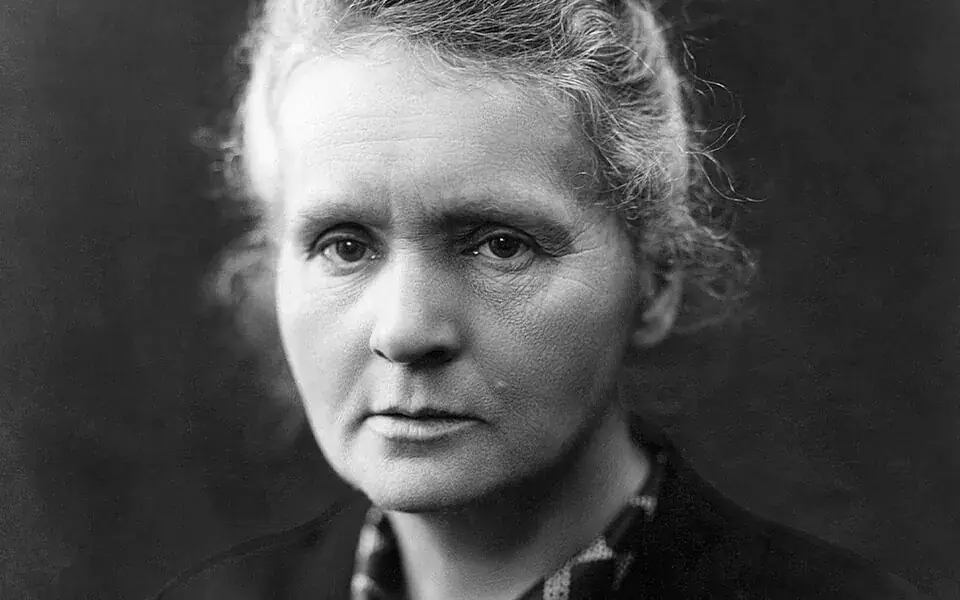
Marie Curie first received the Nobel Prize in Physics and later the prize in Chemistry, for work connected respectively with radioactivity and newly identified elements.
She collaborated with Pierre Curie and others and promoted the use of X-ray equipment during the First World War. Her scientific activities encompassed many different tasks.
Nobel Prizes
In December 1903 the Royal Swedish Academy of Sciences awarded Pierre Curie, Marie Curie, and Henri Becquerel the Nobel Prize in Physics, "in recognition of the extraordinary services they have rendered by their joint researches on the radiation phenomena discovered by Professor Henri Becquerel." At first the committee had intended to honour only Pierre Curie and Henri Becquerel, but a committee member and advocate for women scientists, Swedish mathematician Magnus Gösta Mittag-Leffler, alerted Pierre to the situation, and after his complaint, Marie's name was added to the nomination. Marie Curie was the first woman to be awarded a Nobel Prize.
Curie and her husband declined to go to Stockholm to receive the prize in person; they were too busy with their work, and Pierre Curie, who disliked public ceremonies, was feeling increasingly ill. As Nobel laureates were required to deliver a lecture, the Curies finally undertook the trip in 1905. The award money allowed the Curies to hire their first laboratory assistant. Following the award of the Nobel Prize, and galvanised by an offer from the University of Geneva, which offered Pierre Curie a position, the University of Paris gave him a professorship and the chair of physics, although the Curies still did not have a proper laboratory. Upon Pierre Curie's complaint, the University of Paris relented and agreed to furnish a new laboratory, but it would not be ready until 1906.
In December 1904, Curie gave birth to their second daughter, Ève. She hired Polish governesses to teach her daughters her native language, and sent or took them on visits to Poland.
On 19 April 1906, Pierre Curie died in a road accident. Walking across the Rue Dauphine in heavy rain, he was struck by a horse-drawn vehicle and fell under its wheels, which fractured his skull and killed him instantly. Curie was devastated by her husband's death. On 13 May 1906 the physics department of the University of Paris decided to retain the chair that had been created for her late husband and offer it to Marie. She accepted it, hoping to create a world-class laboratory as a tribute to her husband Pierre. She was the first woman to become a professor at the University of Paris.
Curie's quest to create a new laboratory did not end with the University of Paris, however. In her later years, she headed the Radium Institute (Institut du radium, now Curie Institute, Institut Curie), a radioactivity laboratory created for her by the Pasteur Institute and the University of Paris. The initiative for creating the Radium Institute had come in 1909 from Pierre Paul Émile Roux, director of the Pasteur Institute, who had been disappointed that the University of Paris was not giving Curie a proper laboratory and had suggested that she move to the Pasteur Institute. Only then, with the threat of Curie leaving, did the University of Paris relent, and eventually the Curie Pavilion became a joint initiative of the University of Paris and the Pasteur Institute.
In 1910 Curie succeeded in isolating radium; she also defined an international standard for radioactive emissions that was eventually named for her and Pierre: the curie. Nevertheless, in 1911 the French Academy of Sciences failed, by one or two votes, to elect her to membership in the academy. Elected instead was Édouard Branly, an inventor who had helped Guglielmo Marconi develop the wireless telegraph. It was only over half a century later, in 1962, that a doctoral student of Curie's, Marguerite Perey, became the first woman elected to membership in the academy.