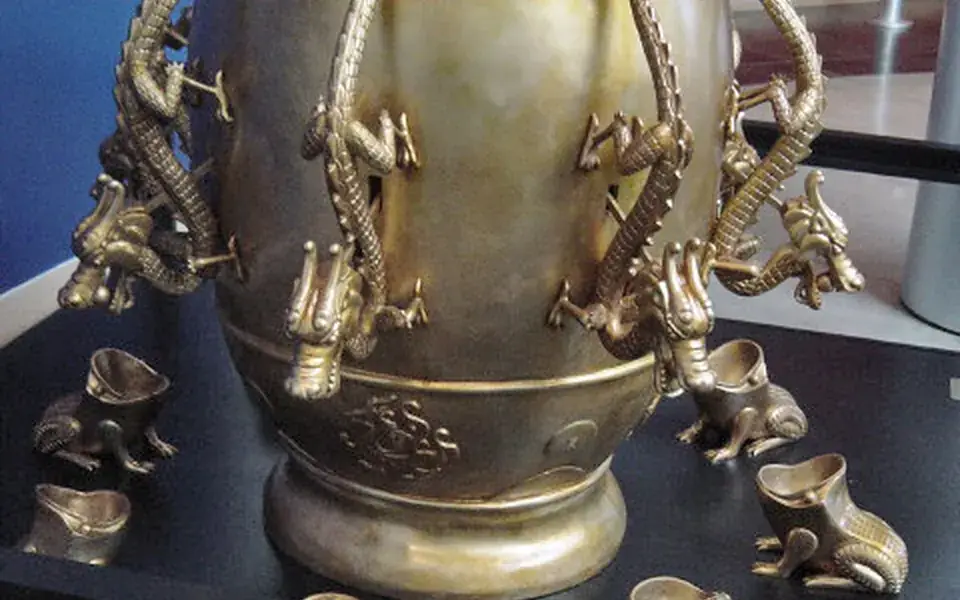
Historical accounts describe Zhang Heng's earthquake instrument as a mechanism that released a bronze ball from a dragon's mouth corresponding to a direction, signaling where a distant earthquake had occurred.
The original instrument has not survived, and its internal structure remains debated. Modern reconstructions are models based on written descriptions and proposed principles.
Zhang's seismoscope
From the earliest times, the Chinese were concerned with the destructive force of earthquakes. It was recorded in Sima Qian's Records of the Grand Historian of 91 BC that in 780 BC an earthquake had been powerful enough to divert the courses of three rivers. It was not known at the time that earthquakes were caused by the shifting of tectonic plates in the Earth's crust; instead, the people of the ancient Zhou dynasty explained them as disturbances with cosmic yin and yang, along with the heavens' displeasure with acts committed (or the common peoples' grievances ignored) by the current ruling dynasty. These theories were ultimately derived from the ancient text of the Yijing, in its fifty-first hexagram. There were other early theories about earthquakes, developed by those such as the ancient Greeks.
Anaxagoras (c. 500–428 BC) believed that they were caused by excess water near the surface crust of the earth bursting into the Earth's hollows; Democritus (c. 460–370 BC) believed that the saturation of the Earth with water caused them; Anaximenes (c. 585–c. 525 BC) believed they were the result of massive pieces of the Earth falling into the cavernous hollows due to drying; and Aristotle (384–322 BC) believed they were caused by instability of vapor (pneuma) caused by the drying of the moist Earth by the Sun's rays.
During the Han dynasty, many learned scholars—including Zhang Heng—believed in the "oracles of the winds". These oracles of the occult observed the direction, force, and timing of the winds, to speculate about the operation of the cosmos and to predict events on Earth. These ideas influenced Zhang Heng's views on the cause of earthquakes.
In 132, Zhang Heng presented to the Han court what many historians consider to be his most impressive invention, the first seismoscope. A seismoscope records the motions of Earth's shaking, but unlike a seismometer, it does not retain a time record of those motions. It was named "earthquake weathervane", and it was able to roughly determine the direction (out of eight directions) where the earthquake came from. According to the Book of Later Han (compiled by Fan Ye in the 5th century), his bronze urn-shaped device was reported to indicate the direction of a distant earthquake. Proposed modern reconstructions often use a pendulum, but the surviving description does not establish the original internal mechanism. This was essential for the Han government in sending quick aid and relief to regions devastated by this type of natural disaster.
The Book of Later Han records that, on one occasion, Zhang's device was triggered, though no observer had felt any seismic disturbance; several days later a messenger arrived from the west and reported that an earthquake had occurred in Longxi (modern Gansu Province), the same direction that Zhang's device had indicated, and thus the court was forced to admit the efficacy of the device.
To indicate the direction of a distant earthquake, Zhang's device dropped a bronze ball from one of eight tubed projections shaped as dragon heads; the ball fell into the mouth of a corresponding metal object shaped as a toad, each representing a direction like the points on a compass rose. One proposed reconstruction uses eight mobile arms, one for each direction, connected to cranks and catch mechanisms around the vessel. When tripped, a crank and right angle lever would raise a dragon head and release a ball which had been supported by the lower jaw of the dragon head. This proposed reconstruction also includes a vertical pin passing through a slot in the crank, a catch device, a pivot on a projection, a sling suspending the pendulum, an attachment for the sling, and a horizontal bar supporting the pendulum. These parts describe a reconstruction hypothesis; they are not surviving components of Zhang Heng's original instrument.
Wang Zhenduo argued that the technology of the Eastern Han era was sophisticated enough to produce such a device, as evidenced by contemporary levers and cranks used in other devices such as crossbow triggers.